






What Is an Employee Super App in 2026 (or Why Your Workforce Deserves Better)
The average frontline worker navigates between six and ten separate workplace applications to get through a single shift. Clocking in on one platform, checking company news on another, filling out timesheets somewhere else, submitting leave requests through a third system entirely. The result is not productivity. It is cognitive overload, wasted time, and a workforce that feels disconnected before the working day has properly begun.
An employee super app solves this directly. At its core, it is a unified mobile application that consolidates every tool, service, and communication channel a workforce needs into a single platform — scheduling, payroll access, training, recognition, HR management, and more, all accessible from one app on any smartphone. Think of it as the swiss army knife of workplace technology: not the flashiest individual tool, but the one a well-equipped organisation cannot function without.
Gartner identified super apps as one of its top strategic technology trends, and the logic is clear. Organisations that continue to fragment the employee experience across multiple apps are paying a productivity tax they can no longer justify.
 Dr. Nirmalarajah Asokan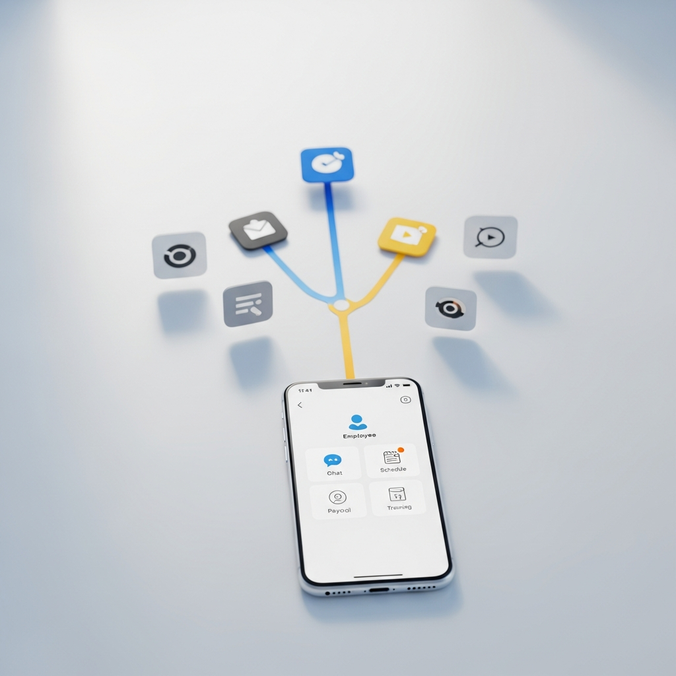
Key Takeaways
1. An employee super app is a single mobile platform that replaces multiple separate workplace tools. An employee super app is defined as a unified mobile application that consolidates the full range of tools and services employees need for their working day into one place. Rather than asking staff to download and manage separate apps for communication, scheduling, payroll, training, and HR self-service, the super app model brings all of these functions together in a single interface.
2. App overload creates a measurable "toggle-tax" that damages productivity, engagement, and work-life balance. When employees are required to move between multiple applications throughout their working day, the cumulative cost in attention, time, and frustration is significant. Research identifies this as the toggle-tax: the cognitive and operational overhead generated by fragmented tooling. For frontline workers with limited administrative time, this cost is particularly acute.
3. Frontline and deskless workers are the primary beneficiaries of a well-designed employee super app. Employee super apps are smartphone-first by design and do not require company email accounts, corporate devices, or desktop access. This makes them the first genuinely accessible digital tool for workers who have long been excluded from the connected employee experience. Giving frontline staff access to company news, payroll information, earned wage access, training, and HR self-service is not a welfare initiative. It is a retention strategy backed by measurable data on employee engagement and turnover reduction.
4. Self-service HR, earned wage access, recognition, and AI personalisation are now the baseline, not a premium. The features that define a best-in-class employee super app have evolved rapidly. Employees in 2026 expect self-service access to leave requests, timesheets, and payroll information as a standard — not something they should have to call HR to manage. Earned wage access, which allows workers to draw down wages already earned ahead of the standard pay cycle, is becoming a differentiating benefit in frontline hiring and retention.
5. Investing in a genuine employee super app produces measurable outcomes across retention, engagement, and operational efficiency. Employee super apps do not just improve the employee experience in abstract terms. They generate measurable business outcomes. Retention improves because workers feel that their employer has invested in making their working life easier. Engagement improves because friction disappears and self-service capabilities give employees a sense of autonomy over their own data and schedules. Operational efficiency improves because workflows are automated, information is standardised, and leaders have access to real-time insights and reports that manual or fragmented systems cannot provide.

Insights for Better Internal Communication
Once a month: practical ideas, research, and real-world examples related to operational staff, internal communication, and frontline HR — delivered straight to your inbox.
Why Multiple Apps Are Quietly Breaking Your Employee Experience
The workplace technology stack has become unmanageable. Over the past decade, companies have added tools layer by layer: a communication platform here, a learning management system there, an app for scheduling, another for payroll, one more for incident reporting. Each addition seemed rational in isolation. The cumulative effect is friction at scale.
Constantly switching between applications creates what researchers describe as a toggle-tax: a measurable drain on focus and efficiency that compounds across every shift. For frontline teams in logistics, retail, manufacturing, or healthcare, this is not a minor inconvenience. Workers cannot afford to lose minutes each shift hunting for the right app, re-authenticating, or downloading another update. And 70% of smartphone users check notifications within 10 minutes of receiving them — yet if those notifications come from six different apps, the signal becomes noise.
Multiple employee apps also increase demand on IT resources. Each platform requires integration, maintenance, user provisioning, and its own security posture. The cost of managing this infrastructure adds up, in money, in time, and in technical complexity. Meanwhile, employees quietly stop using tools that feel too cumbersome to access.
App overload creates friction and poor workplace experiences. Friction is the enemy of a connected, engaged workforce.

Reach your operational teams 80% faster and more reliably
Flip's mobile app combines messaging, chat, HR tools, and your knowledge base in one secure application. No additional tools or licences required.
What an Employee Super App Actually Is — And What It Isn't
An employee super app is a unified mobile application that brings together the tools and services employees need to manage their work. Not just communication. Not just HR. Everything: company news, schedules, timesheets, leave requests, payroll information, training modules, recognition, incident reports, and more, all under one roof.
The analogy to Uber is instructive. Uber started as a ride-hailing app and evolved into a platform that manages payments, deliveries, and loyalty programmes within a single interface. An employee super app follows the same logic: it starts by solving one problem and earns the right to become the access point for an employee's entire work life.
What it is not is a portal nobody visits. The distinction matters. Many companies already have an intranet or HR system they consider their central hub. In practice, these platforms tend to be desktop-first, rarely updated, and invisible to the frontline workforce. An employee super app is mobile-first, push-notification-driven, and designed around how workers actually interact with their phones. It meets employees where they are, not where IT expects them to be.
How an Employee Super App Transforms Employee Engagement
Employee engagement is one of the most discussed and least reliably measured metrics in the modern workplace. UK businesses lose billions each year to disengagement — a cost that compounds through absenteeism, turnover, and reduced productivity. Employee super apps address engagement not as a cultural initiative but as an infrastructure problem.
When employees can access everything they need through a single, well-designed mobile application, the daily friction that erodes goodwill disappears. Self-service access to HR tasks — submitting leave requests, reviewing payslips, tracking training progress, managing schedule changes — reduces the sense of dependency that makes workers feel powerless in large organisations. They stop waiting for a manager to answer a routine question and start managing their own working life.
Centralised activity feeds foster a sense of community among employees. When the whole company can read the same company news, react to the same announcements, and connect with colleagues across sites and shifts, the organisation starts to feel like a community rather than a collection of disconnected departments.
Continuous feedback systems are essential for measuring employee sentiment and engagement over time. Rather than relying on annual surveys, leaders get real-time insights into how their workforce feels, can identify issues early, and respond before dissatisfaction calcifies into attrition. Add AI-driven personalisation — which filters notifications, learning recommendations, and content by role, location, or department — and you have a platform that is relevant to each individual worker, not just broadcast-friendly for head office.
The Features That Define a Best-in-Class Employee Super App
Not every platform calling itself an employee super app earns the title. The difference between a genuine super app and a rebranded chat tool lies in the depth and integration of its capabilities.
Communication is the foundation: push notifications for immediate updates, activity feeds for company news, and direct messaging for peer-to-peer and team-level conversation. But genuine breadth goes further. Scheduling and timesheets allow workers to manage their own time without calling a manager. Leave requests can be submitted, tracked, and approved without paper forms or email chains. Payroll information and earned wage access — which allows employees to draw down wages they have already earned ahead of the standard pay cycle — address a financial need that directly influences loyalty and reduces turnover.
Training and learning modules delivered through the app mean that new hires can complete onboarding from anywhere, and experienced staff can access professional development without being tethered to a desktop. This simplifies the new-hire journey and reduces the time it takes for a worker to become fully productive.
Recognition features matter as much as the functional ones. Key features of an employee super app must include worker recognition mechanisms, because an engaged team is one that feels seen. When a manager can send a shout-out through the same app an employee uses to check their shift, the gesture lands with context and immediacy.
Security and compliance cannot be an afterthought. Super apps that centralise sensitive documents and employee records require robust access controls, role-based permissions, and auditability. Organisations in regulated industries need this as a baseline. The best platforms build it in from the start, not as a configuration afterthought.
Frontline Teams Deserve Better: The Case for a Mobile-First Employee App
The workers who gain most from a genuine employee super app are precisely those who have historically been underserved by workplace technology: frontline workers in retail, logistics, manufacturing, hospitality, and healthcare.
These workers rarely have a company email address. They do not sit at a desktop. They cannot attend all-hands meetings on video. For decades, this meant they were excluded from the digital employee experience: no easy access to services, no voice in company-wide communications, no self-service route to manage their own data. The digital divide between desk-based and deskless staff is not just an inconvenience. It is a retention risk with a measurable cost.
Employee super apps create frictionless connections for deskless and remote workers by meeting them where they are: on their smartphones. A warehouse operative in the East Midlands and a store associate in Glasgow both need access to the same core services. A genuine employee super app delivers that equity without requiring a company-issued device or a corporate email account.
These apps support flexible and frontline workforces by providing access to benefits information, mental health support resources, earned wage access, learning paths, and recognition — services previously reserved for office staff. When a company invests in the digital experience of its operational staff, those workers notice. Employee super apps can improve retention by demonstrating investment in the workforce, and in a labour market where frontline attrition runs consistently high, that signal has real commercial value.
Why Flip Is the Employee Super App Built for UK Frontline Teams
The UK market has seen a proliferation of platforms claiming to address the employee experience challenge. Most solve one part of the problem. Few solve the whole.
Flip has been purpose-built to close the gap between what frontline workers need and what legacy workplace technology delivers. Where others offer communication tools with HR features added later, Flip is architected from the ground up as a genuine all-in-one platform: company news, scheduling, leave requests, timesheets, payroll information, earned wage access, training, recognition, and secure document access, all within a single mobile application. There is no need to switch between applications, no toggle-tax, and no separate login for each service.
For organisations managing large frontline workforces, the operational case is as important as the employee experience case. Flip reduces the demand on IT resources by replacing the fragmented app infrastructure that most enterprises have accumulated over years. It enables automation of repetitive HR workflows, from shift-swapping to timesheet approval, and generates the data, reports, and insights that leaders need to manage their teams with accuracy and confidence.
Flip's identity and access management capabilities are designed specifically for deskless workers. Employees who have no company email address can access the platform securely using passkeys, QR codes, or invite-based onboarding — removing the barrier that has traditionally kept frontline staff out of the digital workplace entirely. For sectors like retail, logistics, and healthcare, where the majority of staff have no desk and no corporate IT account, this is not a nice-to-have. It is the prerequisite for everything else.
The result is an employee super app that does not just connect workers to tools. It drives operational excellence as a structural outcome: a more connected workforce, a simplified technology stack, and an employee experience that treats every worker — desk-based or frontline — as a first-class user of the platform.
For UK companies looking to consolidate their employee app landscape and improve both engagement and efficiency, Flip is the platform built to do it properly.
Organisations that have already moved to an employee super app tend to describe the experience the same way: they did not realise how much friction the old system was generating until it was gone. That is the nature of infrastructure improvements. The cost of fragmentation is invisible until it disappears.
For UK companies managing frontline workforces, the question is no longer whether to consolidate the employee app landscape. It is which platform is ready to do it well.
Sources used: Sources: Top Strategic Technology Trends for 2023: Superapps — Gartner, Cell Phone Usage Stats 2026 — reviews.org, The Toggle Tax — Deloitte OCTO
Reach your operational teams 80% faster and more reliably
Flip's mobile app combines messaging, chat, HR tools, and your knowledge base in one secure application. No additional tools or licences required.
Frequently Asked Questions About Employee Super Apps
An employee super app is a unified mobile application that consolidates all the tools and services employees need for their working day into a single platform. This includes internal communication, scheduling, HR self-service, training, payroll access, and recognition, replacing the need for multiple separate applications.
Employee super apps improve engagement by removing the daily friction that erodes goodwill. When employees can manage leave requests, access company news, review pay information, and communicate with colleagues through one app, they spend less time navigating disconnected systems and more time doing meaningful work. Self-service access and continuous feedback tools also give employees a greater sense of autonomy and visibility within their organisation.
Yes — and frontline workers are precisely the audience that benefits most. Employee super apps are smartphone-first and do not require a company email address or a desktop device. This gives warehouse operatives, retail associates, and healthcare workers the same digital access to services and communication that desk-based colleagues have always taken for granted.
A best-in-class employee super app should include: internal communication with push notifications and activity feeds, scheduling and timesheet management, leave request functionality, payroll information and earned wage access, training and learning modules, employee recognition tools, and secure access to HR documents and company policies. The strongest platforms also offer AI-driven personalisation and continuous feedback mechanisms.
By consolidating multiple software subscriptions into one platform, organisations reduce licence costs, IT overhead, and the time spent managing integrations. Employees save time by not having to switch between applications throughout their working day. HR teams save time through workflow automation. A single all-in-one tool is consistently more cost-effective than maintaining a fragmented technology stack.
Operational excellence requires consistent, reliable execution across the workforce. An employee super app supports this by ensuring every worker has access to the same information, tools, and processes, regardless of role or location. Automated workflows, real-time data insights, and reliable communication channels reduce the variability that creates operational risk and management overhead.

Dr. Nirmalarajah Asokan
Dr. Nirmalarajah Asokan is Senior Content Marketing Manager at Flip and writes about topics such as HR digitalization, employee apps, internal communications, and AI transformation. With an academic background and many years of experience in content marketing and SEO, he specializes in practical, data-driven content on employee experience, change management, and digital collaboration for modern organizations.
Don’t forget to share this content

More on the topic of Employee app

Article
Employee app: 10 best tools for internal communication 2025

Article
5 Advantages of an employee app (with examples)

Article
Employee app: How to convince internal stakeholders